
Land title in Morocco: what it really tells you about your plot
Most people searching for "titre foncier Maroc" want one thing first: to look up their land title online. So that is where I begin, with the official service. Then I explain what the administration will not tell you: what a title actually changes when you are preparing to build, what the document really says, and the lines that cost people months when they only discover them at the moment of filing the permit.
Obtaining your land title: go through the official ANCFCC service
The Moroccan land register is maintained by the ANCFCC (the national agency for land registration, cadastre and cartography). It is the only authoritative source. Any third-party website claiming to display the contents of a title is, at best, reproducing out-of-date information.
The official portal is www.ancfcc.gov.ma. Once you have created an account, it gives access to online services allowing you to request documents relating to a title remotely: certificate of ownership, land plan, record of registered entries. Documents are issued digitally with a verification code that lets a third party (bank, notaire, local authority) confirm their authenticity.
What you need to have ready
- The land title number: a number followed by an index identifying the land registry office it belongs to. It appears on the purchase deed, on an older certificate of ownership, on the bank loan agreement or on the tax notice.
- Proof of identity and, depending on the service requested, the capacity in which you are acting (owner, authorised representative, professional).
- An online payment method: issuing fees remain modest, in the range of a few tens to a few hundred dirhams per document in 2026. These amounts change: check the fee displayed at the time of your request on the portal. I do not reproduce them here so as not to publish an incorrect figure.
If you do not know the title number, no online search by name or address is available. In that case you must go in person to the land registry office covering the property, with the title deed or any identifying document, or work through a notaire (notary), an adoul or a chartered land surveyor (IGT) who will carry out the search.
One methodological point I repeat to every client: request a recent certificate of ownership, not a copy of the 2018 one filed away in a folder. A title is a living record. A mortgage, a seizure, an easement or an inheritance may have been registered against it since.
What a land title guarantees, and what it does not
Morocco operates a land registration system inspired by the Torrens system. In practice: at the end of a registration procedure conducted before the land registry, a title is created. That title is final and unchallengeable: it extinguishes any prior rights that were not claimed during the procedure. Once the title exists, no one can contest ownership on the basis of an older deed.
The second principle, just as important in practice: registration creates the right. A real property right that is not registered on the title cannot be enforced against third parties. A signed but unregistered sale agreement, a verbal easement between neighbours, a family division drawn up on plain paper: until it is entered on the title, it does not exist as far as the land registry is concerned.
On the other hand, and this is the confusion I encounter most often, a land title says nothing about your right to build. It guarantees neither:
- the buildability of the plot: this depends on the applicable planning document (development plan, zoning plan), the zoning category, the floor area ratio, the permitted height and the required setbacks;
- the absence of planning easements: road alignment, land reserved for a future public facility, non aedificandi zone, protection perimeter;
- servicing: availability of water, electricity and drainage at the plot boundary;
- the compliance of existing buildings: a title may mention a villa that never had a valid permit.
In other words: the title answers the question "who owns this land". The development plan and the local authority answer "what are you allowed to do with it". These are two separate investigations, and I always carry out the second before drawing a single sketch. The full procedure is set out in my guide to the building permit in Morocco.
Reading a land title line by line
A certificate of ownership often runs to one or two pages. Every block deserves careful reading. Here is the order in which I go through it.
1. Title number and registry index
This identifies the title and the land registry district. Check that it matches the one on your purchase deed: a single mistyped digit is common in the files sent to me, and a permit application filed with the wrong title number comes straight back.
2. Registration application (réquisition d'immatriculation)
This is the reference of the original file that led to the creation of the title. If there is no title yet but only a pending application, you do not own a registered property: the procedure is still under way, and the legal regime is different.
3. Designation, location, nature
Name of the property, municipality, district, declared nature (bare land, built land, subdivision plot). A "agricultural land" classification on a title located in an urban zone deserves checking: changing the designated use is not a matter of a simple stroke of the pen.
4. Surface area (contenance)
The area recorded on the title, in square metres or in hectares, ares and centiares. This is the figure that carries legal weight. It is also the line that causes the most delays, and I come back to it below.
5. Owners and shares
One or more names, with fractions in the case of joint ownership (1/4, 1/3, for example). Where property is held jointly, a single missing signature is enough to freeze a permit application or a sale. Also look out for references to an unsettled estate.
6. Marginal entries and registrations
This is the heart of the document, often at the bottom of the page, sometimes in small print. Here you find mortgages, protective seizures, objections, registered sale agreements, long-term leases, rights of way or of light, pre-emption rights, co-ownership arrangements and charges. A three-word line can matter more than the whole of the rest of the document.
7. Land plan
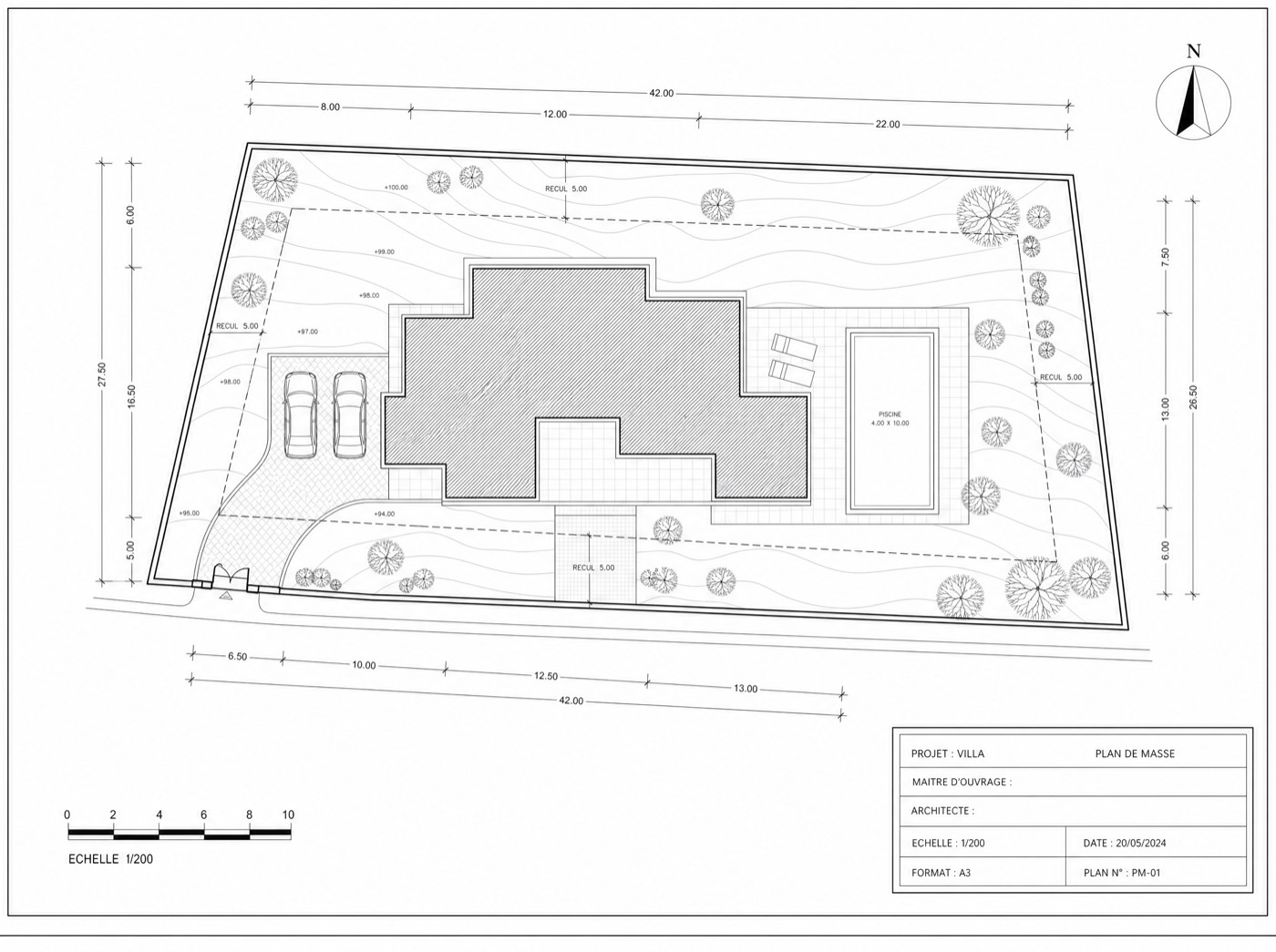
The attached drawing shows the shape of the plot, its dimensions and its boundary markers. Compare it mentally with what you see on site: a boundary wall standing two metres out of place is immediately visible.
Land title, certificate of ownership, planning information note
The three terms are used as if they were interchangeable. They are not, and the various counters do not ask for the same thing.
| Document | What it is | What it shows | Common use |
|---|---|---|---|
| Land title (titre foncier) | The register itself, held by the ANCFCC. It never leaves the registry | The complete legal history of the property | Reference. You do not hold the original |
| Certificate of ownership | An official, dated extract of the title, issued on request | Owner, surface area, current registrations and charges | Sale, bank loan, permit application. Must be recent |
| Planning information note | A document issued by the municipality or the urban agency, unrelated to the ANCFCC | Zoning, floor area ratio, height, setbacks, planning easements | Feasibility study before purchase or before design |
| Land plan | The plot drawing attached to the title | Shape, dimensions, boundary markers, party walls | Basis for the topographic survey and the site plan |
Remember the division of roles: the ANCFCC tells you what you own, the municipality or the urban agency tells you what you can build on it. A client who calls me with only a certificate of ownership has just half the information needed to start designing a villa.
The three possible situations for a plot, and what each one allows
Before any purchase commitment, I ask one question: is the land titled, in the process of registration, or unregistered? The answer shapes the project timeline far more than the surface area or the budget.
| Status | Proof of ownership | Sale and mortgage | Permit application | Points to watch |
|---|---|---|---|---|
| Titled (registered) | ANCFCC certificate of ownership | No obstacle in principle. Bank financing possible | The most straightforward situation | Check marginal entries and surface area |
| Registration in progress (réquisition) | Registration receipt, underlying deeds | Possible but heavier. Banks often reluctant | Often accepted subject to conditions, to be confirmed at the counter | Objections still open, surface area not yet fixed |
| Unregistered (melk, adoular deed) | Melkia or adoular deed, with no central register | Sale possible but risk of a claim | Frequently refused or made conditional on registration | Imprecise boundaries, unidentified heirs |
Alongside these three situations there are special regimes that come up regularly around Casablanca and Rabat: collective land, guich land, habous property, State private domain, and co-owned property. Each has its own rules on transfer. If the deed you are shown refers to one of these regimes, have a notaire check the arrangement before you sign anything.
My advice as a practitioner: when a plot is sold well below market price, the discount is almost always paid for in land status. Regularisation takes months, sometimes years, and it weighs heavily on the final cost of construction simply through holding costs.
What actually blocks a permit application
In Morocco, a building permit application is filed through the Rokhas platform, and it must be submitted by an architect registered with the National Order of Architects in accordance with Law 016-89. Here, file after file, are the land-related issues that cause an application to fail.
The area on the title differs from the surveyor's measurement
This is blocker number one. The title states 412 m², the topographic survey measures 397. The gap comes from a wall taken over by a neighbour, an old road widening, a subdivision incorrectly recorded, or simply a measurement made at a time when instruments were cruder. Yet the site plan submitted must be consistent with the land records. A significant discrepancy means either updating the title with the land registry, or a formal boundary demarcation with the adjoining owners, or a settlement with the neighbour. Allow several weeks to several months. That is why I always have a survey carried out by an IGT before the design is finalised, never after.
A marginal entry discovered too late
A right of way benefiting the neighbouring plot crosses your land exactly where you wanted to put the garage. A registered mortgage prevents the bank from releasing funds. A registered objection freezes the plot. A sale agreement in favour of a third party makes the transaction contestable. Each of these lines fits into a single sentence, and each can mean redrawing the project from scratch. Reading the marginal entries takes ten minutes and saves months.
Unresolved joint ownership
Four heirs, one of them living abroad and one a minor. The permit application requires the owners' agreement. Without a valid power of attorney, and without court authorisation for the minor, nothing moves. This check must happen at the very start, not the day before filing.
A plot from a subdivision that has not been split out
You have bought a plot in a subdivision, but the parent title has not yet been divided and your plot has no individual title. What you hold is a share, not an identified parcel. The counter spots this immediately.
An out-of-date certificate of ownership
Counters generally ask for a recent certificate, often less than three months old. This requirement can vary from one municipality to another: confirm the expected validity period with the relevant counter before assembling your file.
The address on the title no longer matches reality
Street renamed, numbering redone, district redrawn. This can be sorted out, but it requires a certificate from the municipality and takes time.
What I check before drawing, and what this guide is not
On every project, before the first sketch, I assemble a minimum land file made up of four items:
- A recent certificate of ownership and the land plan, obtained from the ANCFCC.
- The topographic survey carried out by an IGT, with levels, surveyed boundaries and existing party walls.
- The planning information note or an extract from the development plan, giving the zoning, floor area ratio, height and setbacks.
- Site observations: actual access, utilities at the boundary, neighbouring buildings, party walls, slope, any protected trees.
This preliminary work is part of what I call the diagnostic, charged at around 1,500 to 2,500 MAD (Moroccan dirhams) in 2026, excluding surveyor's fees and administrative charges. It prevents you from designing an impossible project. Beyond that, a design and permit assignment for a villa of 150 to 200 m² generally falls between 15,000 and 40,000 MAD, and a full assignment including site supervision between 8 and 12% of the works value. These are orders of magnitude to be confirmed by quotation according to the complexity of the site and the brief: the details are on my fees page.
Finally, one point I want to state in black and white: this guide is not legal advice. I write it from my position as an architect, that is, from what I observe in my clients' real files. For the interpretation of a marginal entry, the release of a mortgage, an inheritance division or the validity of a deed, consult a notaire or a lawyer, and for official fees, forms and processing times, contact the ANCFCC or the relevant municipality. Related topics are gathered in my guides, and the question of who to work with depending on the nature of your project is covered in architect or interior architect.
What clients ask me most
Can you check a land title online for free in Morocco?
Consulting a title requires a request to the ANCFCC through its official portal, and the issue of a document (certificate of ownership, land plan) is subject to a fee. These fees remain modest, in the range of a few tens to a few hundred dirhams per document in 2026, but the exact amount should be checked at the time of the request on www.ancfcc.gov.ma. No free third-party service is reliable for this information.
I do not have my land title number. How can I find it?
There is no publicly accessible search by name or address. The number appears on the purchase deed, on an older certificate of ownership, on the bank loan agreement or on tax notices. Failing that, go to the land registry office covering the property with your supporting documents, or work through a notaire, an adoul or a chartered land surveyor.
Can you build on unregistered land?
It is not legally impossible, but in practice it very often blocks the process: counters expect enforceable proof of ownership, and banks rarely provide financing. In most of the cases I come across, you need to start the registration procedure or, at the very least, have the arrangement validated by a notaire before investing in architectural studies.
What should I do if the area on my title does not match the surveyor's measurement?
Do not file anything until the discrepancy is explained. First you need to understand where it comes from: road widening, encroachment by a neighbour, an old subdivision, an imprecise historical measurement. Depending on the case, the solution is a formal boundary demarcation with the adjoining owners, an update of the title with the land registry, or an agreement with the neighbour. A site plan inconsistent with the area on the title will be sent back by the counter.
Is a land title enough to obtain a building permit?
No. The title proves ownership, not the right to build. The permit depends on the development plan, the zoning, the floor area ratio, the permitted height and setbacks, as well as on a complete application filed on Rokhas by an architect registered with the National Order of Architects, in accordance with Law 016-89.
Should the title be checked before signing a purchase agreement?
Yes, and that is the most useful moment to do it. A recent certificate of ownership, a careful reading of the marginal entries and a planning information note cost little and can be obtained within a few days. It is the only way to know whether the land you are buying really allows the project you have in mind.
Unsure about your land before starting the project?
Send me your title number, your certificate of ownership and a few photos of the plot, along with the brief you have in mind. I will tell you what the land status allows, what needs checking first and how to structure the stages. Write to me via the contact page or call +212 661 25 78 84.
A reply as soon as possible