
Choosing bathroom tiles in Morocco
A bathroom is judged ten years after handover, not on the day the tiles go down. In this guide I set out the criteria I actually apply on my sites in Casablanca and Rabat: floor slip resistance, water absorption, waterproofing beneath the tiles, shower falls, grout and maintenance. Prices are indicative figures recorded in 2026 and should be confirmed with your supplier.
Before choosing a tile: the waterproofing nobody sees
The tile itself is the last thing to choose. What determines how long a bathroom lasts is the invisible layer between the substrate and the adhesive. Most of the defects I find during renovations start there: a stain on the living room ceiling, the base of a partition coming away, a skirting board swelling in the room next door.
Tiling is not a waterproofing system. Porcelain stoneware absorbs very little water, but its grout joints are porous and the tile adhesive soaks up moisture. Water that gets through a hairline crack in a joint travels beneath the tiles, saturates the slab and can reappear two years later, three metres from where it entered.
What I always have written into the specification:
- a liquid applied waterproofing membrane (SEL) or a sheet membrane, applied to a sound, clean, dry and level substrate;
- reinforcing tapes in every corner, at the foot of partitions, around the waste outlet and at every tap outlet;
- vertical upstands: around 2.00 m on all three walls of the shower enclosure, at least 20 cm on the remaining walls, and the entire floor treated whenever the bathroom is on an upper level;
- two cross-applied coats, respecting the drying time between them;
- for a walk-in shower, a water test before the tiles are laid.
This item accounts for a modest share of the budget and prevents the complete demolition of a brand-new room. It is also the first thing I check on a site visit, even before flatness.
| Solution | Where I use it | Points to watch | Indicative price (MAD/m²) |
|---|---|---|---|
| Liquid membrane (SEL) | Shower floors and walls, complex geometries, niches | Two cross-applied coats, corner tapes essential | 60 to 150 |
| Sheet waterproofing membrane | Floors over timber or concrete decks, cracked substrates, fast renovation | Careful overlaps and bonding, prefabricated corners | 120 to 250 |
| Ready-to-tile board | Shower bench, low partition, bath panel | Every through fixing must be sealed individually | 250 to 500 |
If your project stays strictly internal, no authorisation is required. However, as soon as you move a load-bearing wall, create a service duct on the façade or alter an opening, a submission through the Rokhas platform becomes mandatory, with an architect registered with the Ordre National des Architectes (National Order of Architects) in accordance with law 016-89. I explain the procedure in my guide to building permits in Morocco.
Floor tiles: slip resistance and water absorption
On the floor, two technical characteristics matter more than looks: the slip resistance rating and the water absorption rate. These are the two lines I ask to see on the product data sheet before approving a sample, and they are not always printed on the box in the showroom.
R ratings and barefoot classification
The R rating measures grip with footwear, on an inclined ramp. The A, B, C classification measures barefoot grip, which is exactly what a bathroom involves. A walk-in shower with no tray calls for a higher rating than the rest of the room: water sits there for a few seconds, mixed with soap.
| Rating | Grip | Barefoot equivalent | Use I recommend |
|---|---|---|---|
| R9 | Low | A | Avoid in bathrooms, even outside the shower |
| R10 | Adequate | A or B | Bathroom floor outside the shower area |
| R11 | Good | B | Walk-in shower, children's or older person's bathroom |
| R12 to R13 | High | C | Hammam, pool surround, plant room. Less comfortable barefoot |
A highly slip-resistant tile is also rougher, so it takes longer to clean. The right compromise in a family bathroom: R10 on the main floor and R11 with a fine texture in the shower, often achieved with the same model in two finishes or in mosaic format.
Water absorption
The more a tile absorbs, the more it stains and deteriorates in a damp room. Full-body porcelain stoneware absorbs less than 0.5 % of its weight; a glazed ceramic wall tile can exceed 10 %, which rules it out for floors. In windowless bathrooms, very common in Casablanca apartments, I always specify low-absorption porcelain and combine it with mechanical extraction.
| Material | Strengths | Limitations | Supply price (MAD/m²) |
|---|---|---|---|
| Full-body porcelain stoneware | Very low absorption, colour right through the thickness | Cutting and drilling are more demanding | 150 to 400 |
| Glazed porcelain stoneware | Very wide choice of stone, concrete and terrazzo looks | Glaze vulnerable on edges | 90 to 250 |
| Wood-effect porcelain | Visual warmth, planks available in R10 and R11 | Many joints, setting-out must be drawn | 120 to 300 |
| Marble or travertine | Noble material, unique veining | Porous, needs sealing, slippery if polished | 400 to 1,200 |
| Microcement | Continuous surface, no joints | Specialist applicator essential | 300 to 700 |
Wall tiling: formats, height and zellige
On walls the technical constraints ease off: no slip resistance, no abrasion resistance to worry about. The subject becomes format, setting-out and the quality of the finishes. So I always deal with the walls once the floor has been settled, never the other way round.
Three decisions shape the result:
- Tiling height. Full height in the shower, without exception. Elsewhere, I choose between full height, a clean stop at 1.20 m or 2.10 m with water-resistant paint above, or a simple 30 cm splashback behind the basin. A badly positioned intermediate stop cuts the room in two: it should line up with a lintel, a mirror or the top of a door.
- Format. Large formats mean fewer joints and easier cleaning, but they require a very flat wall and a properly prepared substrate. Small formats and zellige forgive irregularities and add texture.
- Edge details. Aluminium or stainless steel trim, rectified-edge tile, or a 45 degree mitre. It is a 2 cm detail that the eye spots immediately, and it is often where the difference between two tilers shows.
| Wall finish | Common formats | Effect | Supply price (MAD/m²) |
|---|---|---|---|
| Plain ceramic tile | 20x20, 25x40 | Neutral, economical, widely available | 60 to 150 |
| Bevelled metro tile | 7.5x15, 10x20 | Relief and play of light, retro style | 120 to 300 |
| Large-format porcelain stoneware | 60x120, 75x150 | Few joints, continuous appearance | 180 to 450 |
| Zellige from Fez | 5x5, 10x10, beldi | Handmade vibrancy, no two tiles alike | 300 to 900 |
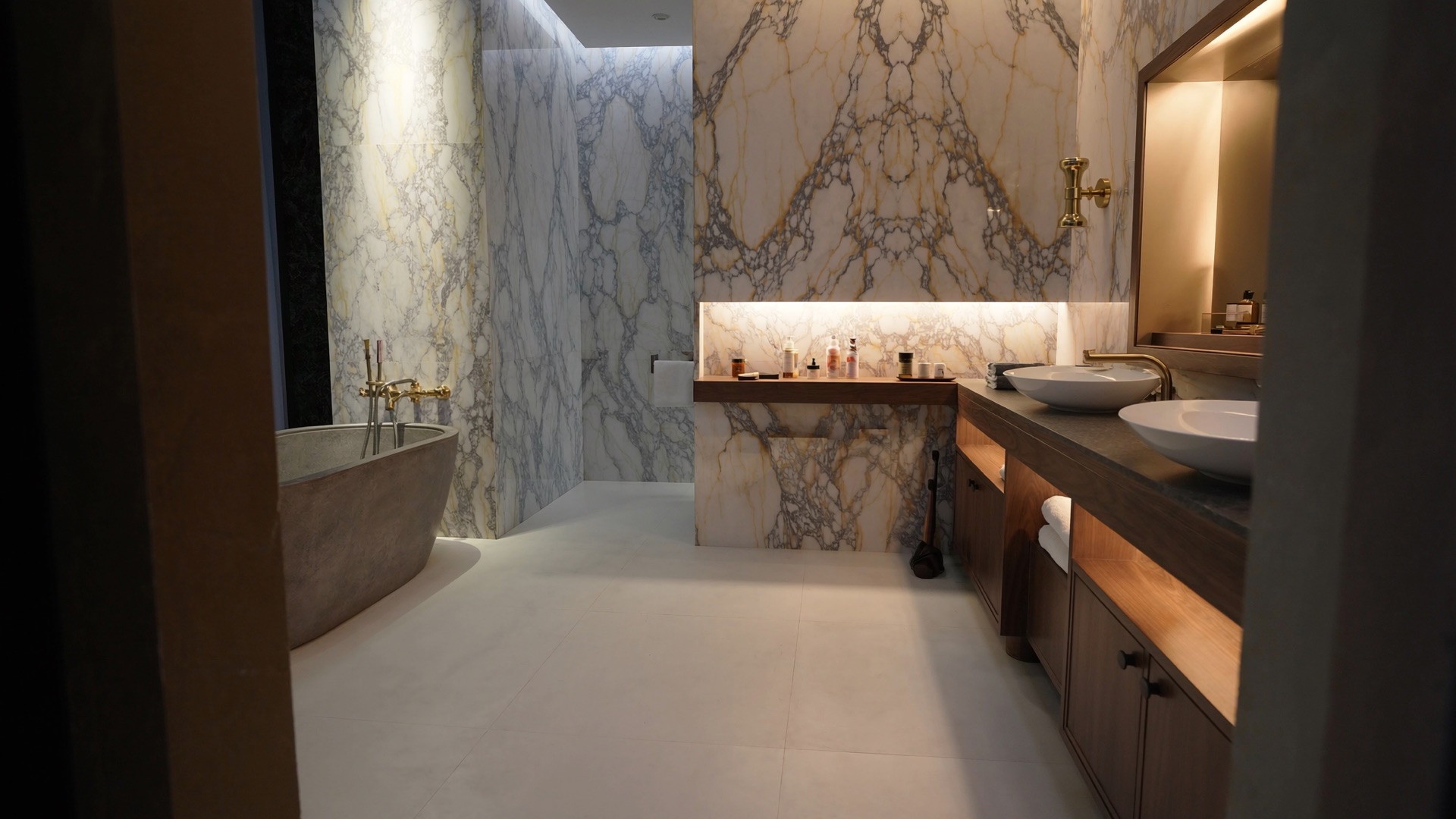
| Marble slabs | Bespoke | Monolithic effect, book-matched veining | 500 to 1,500 |
Glazed zellige works very well in a shower enclosure, provided you accept its uneven surface and a wider grout joint. That is not poor workmanship, it is the material. I keep it for one chosen wall and use plain ceramic or porcelain elsewhere, particularly on interior architecture projects in Casablanca where the budget has to be kept under control.
Shower falls, setting-out and cut lines
A successful walk-in shower comes down to three dimensions set on the drawing, not on site.
The fall. I aim for 1.5 % towards the waste, roughly 1.5 cm per metre, with a minimum of 1 % and a maximum of 2 % to stay comfortable underfoot. Too shallow and water sits and marks the joints. Too steep and you feel the slope, while large tiles no longer follow it.
The type of drainage. A central waste requires four converging falls and therefore diagonal cuts: it does not suit large formats. A linear channel drain placed against the wall or at the edge of the shower allows a single fall and a large tile laid in one piece. That is almost always my preference in renovation work.
Setting-out. I draw the tile layout before ordering, starting from the most visible points: the basin axis, the shower axis, the line of the niche. The aim is to avoid cuts smaller than a third of a tile in visible corners, and to align floor and wall joints where the formats allow. This work happens at the same time as the technical drawing of the room, as I explain in my guide to villa plans.
Two provisions to allow for at drawing stage: the shower niche (30 to 40 cm wide, one or two tiles high, with a slight inward slope for drainage) and the threshold, which must stay level with the rest of the room for a step-free shower.
Grout: width, colour and real-world cleaning
Grout is the part of a tiled surface that ages. On a shower floor, it is the grout that turns black, not the tile.
- Width. 2 mm on a rectified tile, 3 to 5 mm on a natural-edge tile, more for zellige. A joint that is too narrow on a non-rectified tile leaves visible lippage.
- Type. Water-repellent cement grout works everywhere, is easy to repair but gets dirty. Epoxy grout is impermeable and resists cleaning products, but it costs more and needs a tiler used to it: applied carelessly, it leaves a haze that cannot be removed. I keep it for shower floors and walls, and use cement grout elsewhere.
- Colour. This is what clients regret most. White grout in a shower turns grey within eighteen months, especially with the hard water in Casablanca and Rabat. I choose a mid grey, a taupe or a shade slightly darker than the tile: ageing then becomes invisible.
- Corners. All internal corners, the floor-to-wall junction and the bath surround are sealed with sanitary silicone, never with rigid grout. Silicone is replaced every five to eight years; that is normal maintenance.
A final word on natural stone: marble, travertine and terrazzo need a sealer at installation and periodic re-application. If nobody in the household will keep up with that, a stone-effect porcelain tile is the sensible choice.
Indicative prices, recorded in 2026
The figures below are indicative for a bathroom of 5 to 8 m² in Morocco, excluding sanitaryware and taps. They vary with the city, the supplier, the format and the difficulty of installation, and must be confirmed by a quotation and a measured take-off.
| Item | Unit | Indicative range (MAD) | Note |
|---|---|---|---|
| Floor tiles, entry level | m² | 90 to 180 | Glazed porcelain, standard formats |
| Floor tiles, mid to high end | m² | 200 to 450 | Full-body porcelain, large formats |
| Ceramic wall tiles | m² | 60 to 200 | Excluding zellige and stone |
| Zellige or marble | m² | 300 to 1,500 | Allow for slower installation |
| Waterproofing under tiles | m² | 60 to 250 | Depending on liquid or sheet membrane |
| Tile laying | m² | 90 to 200 | Surcharge for large formats and cuts |
| Epoxy grout | m² | 50 to 120 | Specialist labour |
Keep one simple rule of thumb in mind: supplying the tiles rarely exceeds 40 % of the cost of the finished surface. The rest is preparation, waterproofing and installation, in other words the part you should never cut back on. To place these figures within an overall works budget, my guide to construction prices in Morocco covers the other items, and my fees are set out separately: an on-site assessment costs between 1,500 and 2,500 MAD (Moroccan dirhams), and a full interior architecture commission represents 10 to 20 % of the value of the works.
Mistakes to avoid
These are the five situations I come across most often when surveying a property before works.
- Tiling with no waterproofing. This is the most expensive mistake of all. Tiles laid directly on screed, even with a so-called water-resistant adhesive, do not protect the structure. Putting it right means demolishing the whole room and often the ceiling below.
- Choosing a polished tile in a wet area. Polished marble or glossy porcelain in a shower is dangerous, especially for a child or an older person. The same material exists in honed, sandblasted or tumbled finishes, rated R10 or R11.
- Forgetting the fall, or leaving it to the last minute. A fall improvised by the tiler in the adhesive bed produces permanent puddles. The sloped screed must be planned within the screed thickness, before waterproofing, with the waste level confirmed by the plumber.
- Underestimating the upkeep of light-coloured grout. White grout on a shower floor is a showroom aesthetic, not a daily-use choice. The same goes for a heavily textured matt porcelain on a large floor: beautiful, but it holds limescale.
- Ordering with no allowance and no spares. I allow 10 % waste for straight laying and 15 % for diagonal or large-format work, plus a few tiles kept in store for future repairs. Firing batches differ from one delivery to the next: a tile bought two years later will not be the same shade.
To these five I would add an organisational mistake: choosing the tiles before the layout of the sanitaryware and ventilation has been settled. The correct order is technical drawing, then waterproofing, then finishes. You will find examples of this method in my projects and in the practice's other guides.
What clients ask me most
Do I need slip-resistant tiles throughout the bathroom?
No, but I never go below R10 on the main floor area. In the shower itself, particularly a walk-in shower with no tray, I move up to R11 or mosaic, because soapy water sits there for a few seconds. Barefoot classification B matches real bathroom use well.
Can marble be used in a shower in Morocco?
Yes, on three conditions: an unpolished finish, a sealer applied at installation and renewed periodically, and careful waterproofing underneath. Marble is porous: untreated, it stains and takes on an uneven tone after a few years. If nobody will keep up the maintenance, stone-effect porcelain is safer.
What tile format suits a small 4 m² bathroom?
A medium to large format, between 60x60 and 60x120, reduces the number of joints and visually enlarges the room, provided the floor is very flat. The main enemy of a small room is not the format but the setting-out: a 4 cm cut in a visible corner ruins the effect, whatever the tile.
Is epoxy grout essential?
It is very useful on shower floors and exposed walls, where it prevents blackening. Elsewhere, a properly installed water-repellent cement grout is enough and is easier to repair. Epoxy requires a tiler who is used to it: if it is not cleaned off properly, it leaves a lasting haze on the glaze.
How long does a full bathroom renovation take?
The programme depends on the site, access to the building and material lead times, particularly for zellige and stone. I prefer to draw up a schedule after a visit rather than quote a standard duration. What I can guarantee is the sequence: strip out, plumbing, sloped screed, waterproofing, drying, tiling, grouting, sanitaryware.
Do I need an architect for a single bathroom?
Not necessarily. An on-site assessment with a technical specification and tile setting-out is often enough to brief the contractors. A full commission makes sense if you are renovating several rooms, moving partitions or want site supervision. I take on this type of work in Casablanca as well as Rabat.
Let's talk about your bathroom
Tell me about the room: floor area, storey, whether there is a window, shower or bath, photos of the existing space and the budget you have in mind. I will tell you frankly what is simply a matter of choosing materials and what calls for waterproofing or plumbing work. Write to me via the <a href="/en/contact">contact</a> page or call +212 661 25 78 84.
A reply as soon as possible