
Interior architect in Marrakech
Marrakech is the city where Moroccan craftsmanship is most readily available and best mastered. That is a considerable advantage in interior architecture, provided you know exactly what to ask for and how to check it.
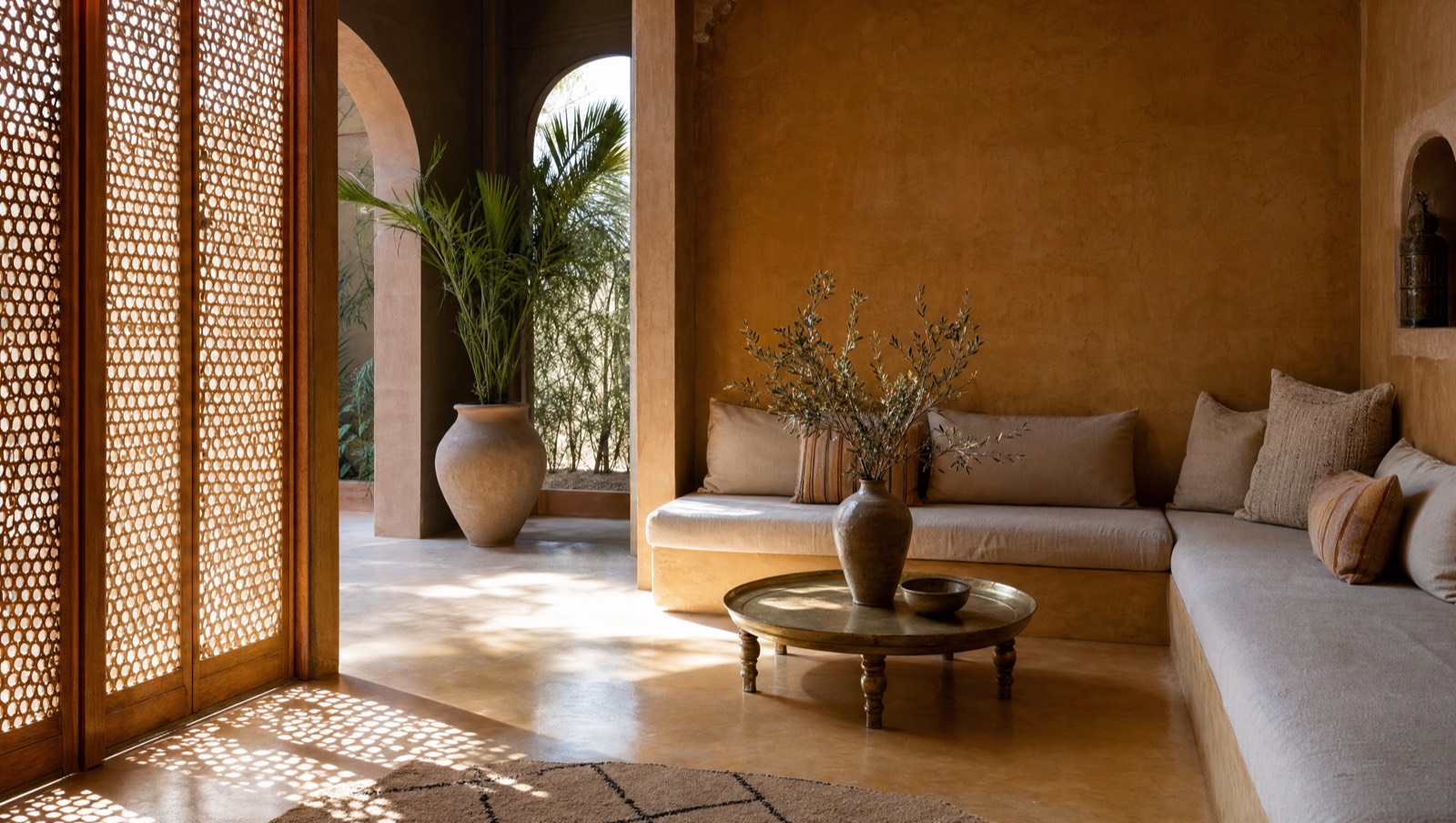
A local advantage that has to be managed
Tadelakt, zellige, carved plaster, ironwork, cedar joinery: these trades are alive in Marrakech and cost less than elsewhere. But they cannot be ordered over the phone. Successful tadelakt depends on the craftsman's hand and on drying times, zellige on a setting-out plan agreed before laying, ironwork on a prototype approved before the full run.
The method is therefore simple and non-negotiable: a full-size sample, approval on site, then a visit after fabrication and before finishing. It is that intermediate check that separates a successful handcrafted interior from an approximate one.
Heat, in turn, shapes the choice of materials as much as the architecture: cool floors, breathable textiles, colours that do not bounce back the harsh light, and artificial lighting designed as indirect so it does not add to the perceived heat.
Riad, villa, guesthouse
Riads in the medina: old structure, damp, protected heritage area. The interior is designed at the same time as the structural repairs, never afterwards. The method is set out in detail in the case study restoring a riad.
Villas in the Palmeraie, Amelkis and Targa: large volumes, patios, a real demand for coolness. Bespoke work comes into its own here for banquettes, bookcases and headboards.
Guesthouses and short-term rentals: the brief changes. All bedrooms become suites, guest and service circulation are kept separate, storage is closed, materials must withstand heavy use, and photogenic qualities are decided on the plan, not on the day of the photo shoot.
Apartments in Guéliz and Hivernage: fit-out renovations, often without touching the structure.
Five stages, in order
1. Assessment: survey, structure, services, regulatory constraints in the medina. 2. Plan: layout, storage, technical positions. 3. Materials: a short palette, samples approved on site. 4. Bespoke pieces: a few items designed here and made by local workshops. 5. Site works: supervision, snagging, handover.
Two case studies describe this process in detail: interior architecture of a duplex and a collection of bespoke furniture.
What a commission costs in Marrakech
Fees range from 10 to 20% of the value of the works, with an initial assessment of 1,500 to 2,500 MAD (Moroccan dirhams) deducted if the commission goes ahead: see the fees page.
As for the works themselves, local craftsmanship delivers a higher level of finish for the same budget, provided you accept sometimes longer lead times and tighter supervision. For new build, permits and villas, the dedicated page is architect in Marrakech.
What clients ask me most
How much does an interior architect cost in Marrakech?
Between 10 and 20% of the value of the works depending on the scope of the commission, with an initial assessment of 1,500 to 2,500 MAD deducted if the commission goes ahead.
Can tadelakt and zellige be made to order?
Yes, these are the most widely available crafts in Marrakech. They do, however, require full-size approved samples and a setting-out plan agreed before laying, otherwise the result is unpredictable.
Is fitting out a guesthouse different from a private home?
Yes. Guest and service circulation are separated, bedrooms become suites, storage is closed off and materials have to withstand intense use. Photogenic qualities are decided on the plan, not on the day of the photos.
Do you work in the Marrakech medina?
Yes, on riads and traditional houses. The protected heritage area requires specific authorisations and limits changes to the exterior appearance: the regulatory review is carried out at the assessment stage.
Tell me about your interior in Marrakech
Riad, villa, apartment or guesthouse: you will receive an initial architect's reading of your project and an outline of a commission suited to it.
A reply as soon as possible