
Architect in Marrakech
In Marrakech, a project is won or lost on two factors: heat and orientation. The practice designs villas, riads and guest houses starting from those, long before any discussion of materials.
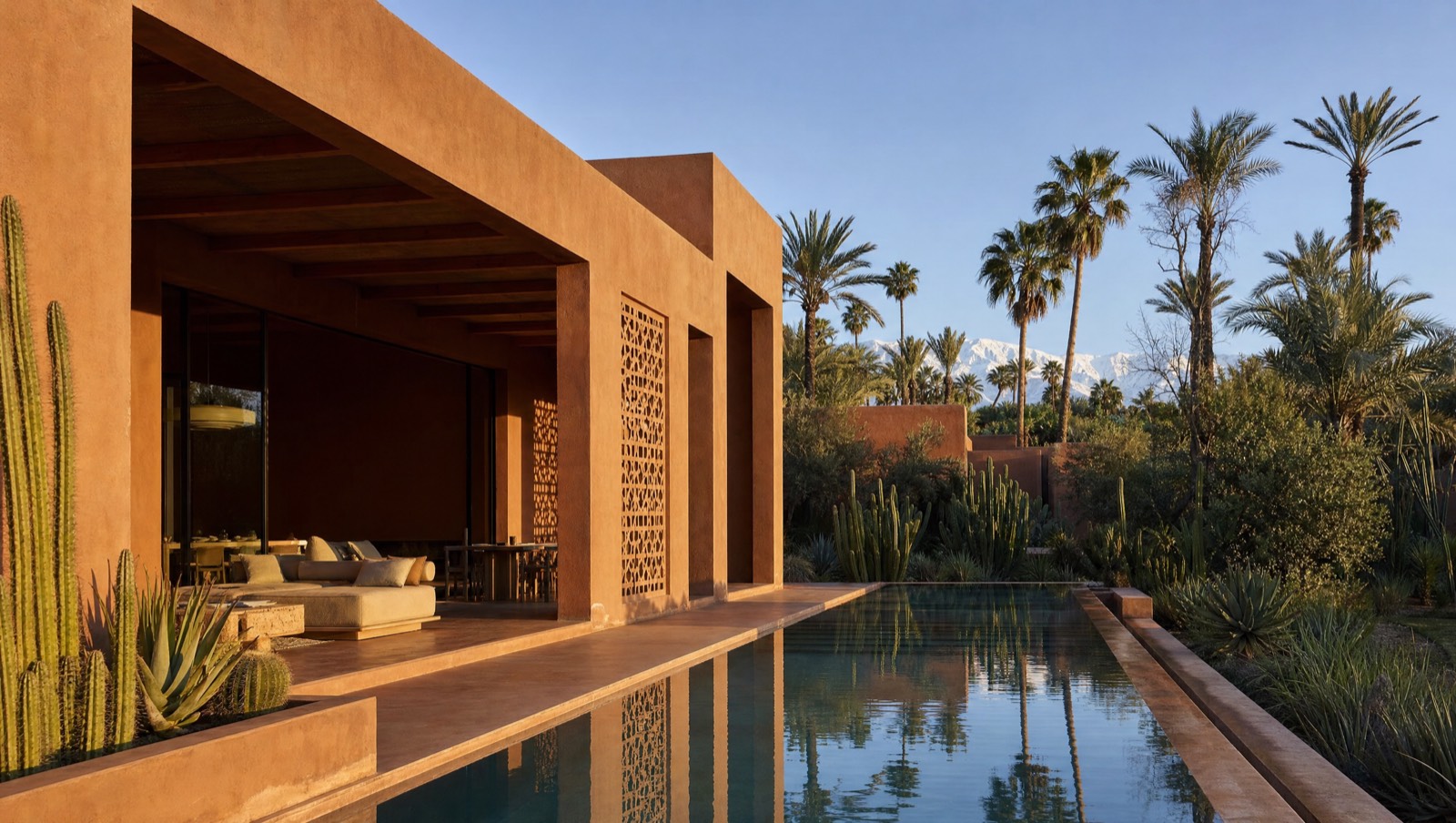
What Marrakech demands of a floor plan
The dominant constraint is not aesthetic, it is thermal. A poorly oriented villa in Targa or on the Ourika road becomes unliveable from June to September without running the air conditioning non-stop. The plan is therefore built around shade: a patio, deep loggias, west facades kept almost closed, heavy thermal mass on the south side.
The second factor is light. It is fierce here: large unprotected glazed openings, imported unchanged from a Casablanca project, create a greenhouse effect. Shading devices, moucharabiehs, brise-soleil and overhangs are not regional decorative motifs, they are technical components sized for the job.
Finally, a significant share of Marrakech projects is aimed at short-term rental. That changes the brief: separate guest and service circulation, all bedrooms en suite, a pool visible from the living room, and a level of photogenic quality the plan has to anticipate.
Area by area
Guéliz and Hivernage: dense urban fabric, mostly apartment renovations and fit-outs for shops or offices. Co-ownership rules and site access are the main constraints.
Palmeraie, Amelkis, Targa, Ourika road: villas on large plots, often with a pool. The main issue is siting in relation to prevailing winds, overlooking neighbours and existing trees, some of which are protected.
Medina: riads and traditional houses in a protected heritage area. Specific approvals apply, certain exterior features cannot be altered, and old structures need to be reinforced. This is the most technical case and the longest to process.
For a riad, the method is set out in detail in the case study riad rehabilitation.
What the practice handles
Site survey and regulatory review of the plot, concept design and preliminary design, permit application submitted through Rokhas, contractor tendering, then site supervision with regular meetings and written reports. Interior architecture and bespoke furniture can be included in the same commission, which avoids the usual break between structural works and fit-out.
Fees follow the scale published on the fees page: around 8 to 12 % of the works cost for a full commission, a fixed fee of 15,000 to 40,000 MAD (Moroccan dirhams) for a design and permit commission on a villa of 150 to 200 m², and 10 to 20 % for an interior commission.
Typical costs in Marrakech
Construction costs in Marrakech fall within the same ranges as in the rest of the country, with two differences: skilled traditional craftsmanship (tadelakt, zellige, carved plaster) is more readily available and often cheaper than in Casablanca, while imported high-end finishes cost slightly more to bring in.
The budget calculator gives ranges by quality level, including fees and studies. For the permit, the full process is set out in the Rokhas guide.
What clients ask me most
Does the practice work in Marrakech?
Yes. The practice designs and supervises projects in Marrakech as elsewhere in the Kingdom: villas, riads, guest houses and commercial spaces. On-site meetings are scheduled into the project timetable from the moment the contract is signed.
How much does an architect cost in Marrakech?
For a full commission, around 8 to 12 % of the works cost. For a commission limited to design and the building permit, expect a fixed fee of 15,000 to 40,000 MAD for a villa of 150 to 200 m². Every proposal sets out the included phases in writing.
Can a riad in the Marrakech medina be renovated?
Yes, but the protected heritage area requires specific approvals and limits changes to the exterior appearance. Ideally the regulatory review is carried out before purchase, as some projects simply cannot be built on certain plots.
How long does a building permit take in Marrakech?
The application is submitted through Rokhas, as everywhere in Morocco. Allow several weeks of processing for a standard project, and longer in heritage areas or where additional opinions are required.
Tell me about your Marrakech project
Plot, riad or apartment: three minutes are enough, and you receive an initial architect's assessment and a clear budget framework.
A reply as soon as possible