
Tadelakt in Morocco: composition, uses and price per m²
Tadelakt is the material I specify most often when a project calls for a continuous, mineral surface with no joints. It is also the one that generates the most misunderstandings: it is sometimes used where it will not last, it is cleaned with products that destroy it, and renders that are not tadelakt at all are sold under that name. This guide sets out what I check before writing it into a specification: actual composition, suitable rooms, substrate, drying times, maintenance and indicative price ranges.
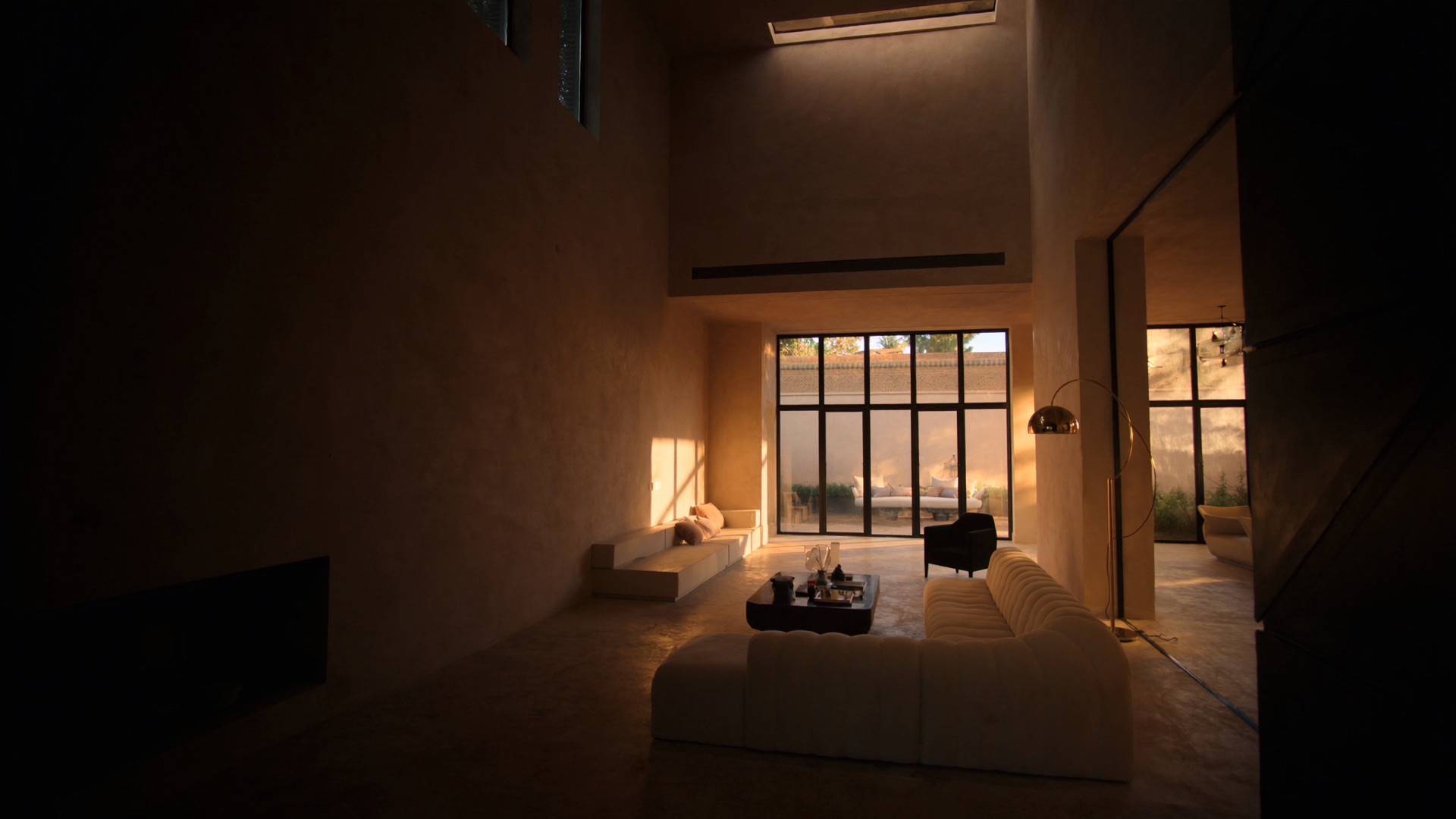
What tadelakt actually is
Tadelakt is not just another decorative finish: it is a render made from air lime, compressed and polished with stone, whose water resistance comes from the way it is applied rather than from any added product. The word comes from the Moroccan Arabic dellek, meaning to rub or to massage: that says it all, the material takes its qualities from the gesture.
The traditional composition is simple and uses only four ingredients:
- Marrakech lime: an air lime produced from the marly limestone of the region, fired and then slaked. It naturally contains clays and silicates that give it its creamy texture and a slight hydraulic set. That is what sets it apart from a pure commercial air lime.
- Mineral pigments: iron oxides, chromium oxides and natural earths, usually dosed at 2 to 10 % of the weight of lime. Beyond that, the render is weakened. Light shades (off-white, sand, pearl grey) are the most stable; deep reds, blues and blacks call for an experienced maâlem and come with variations in tone.
- Black soap (potassium olive soap), applied diluted onto the still-fresh render. It reacts with the lime to form insoluble calcium salts: this is the heart of the water-repellent effect.
- Water, and the craftsman's touch. Nothing else: no resin, no cement, no acrylic.
Polishing is done with a river pebble or an agate stone, in two or three passes, once the render has begun to set. This compression closes the surface porosity and brings out the characteristic satin lustre, with its clouding and very slight relief. Historically the material comes from cisterns, hammams and riad pools: it was invented for water, not for decoration.
Why it is watertight without a single joint
Three mechanisms work together, and it helps to understand them in order to know where the material performs and where it fails.
- Carbonation: the lime reabsorbs carbon dioxide from the air and slowly turns back into calcium carbonate. The surface hardens over several weeks and continues to gain strength for months.
- Saponification: black soap applied to the fresh render forms, with the lime, a hydrophobic compound that repels water while still allowing vapour through. Tadelakt is water-repellent and breathable: it does not trap moisture inside the wall, unlike tiling bonded to a poorly prepared substrate.
- Mechanical compression: stone polishing crushes the open porosity. Water no longer finds a capillary path.
The absence of joints is the decisive advantage. In a tiled shower, 90 % of problems start at the joints: micro-cracks, mould, corner detachment. A tadelakt surface is monolithic: no line of weakness, no silicone to redo every three years, rounded corners, continuity between wall, bench and niche.
One limit must be stated clearly: tadelakt is a water-repellent finish, not a structural waterproofing system. On a substrate that moves, cracks or stays damp from behind, it will micro-crack in turn. In any area heavily exposed to water, I have a waterproofing layer installed beneath the render (liquid membrane or matting, depending on the substrate) with the tadelakt applied on top as the finish. That is the rule I apply systematically on my interior renovation projects in Casablanca.
Where to use it, where it is risky
Tadelakt is not universal. Here is the matrix I use at design stage, with the heights and dimensions I actually write on the drawings.
| Location | Verdict | Dimensions and points to watch |
|---|---|---|
| Bathroom walls | Ideal | Full height, or up to 210 to 220 cm with a straight edge; rounded corners with a 15 to 20 mm radius |
| Shower walls | Ideal | Liquid waterproofing membrane essential underneath; minimum height 200 cm, 220 cm with an overhead shower |
| Hammam, benches, dome | Original use | On lime mortar; bench falls of 2 % towards the drain; wax finish at the end |
| Basin, one-piece washstand | Good, with reservations | Fall of 1.5 to 2 % towards the waste; avoid standing toothpaste and acidic cosmetics |
| Shower floor with heavy use | Avoid | Abrasion, soaps, daily foot traffic: use a shower tray, zellige or stone instead |
| Kitchen splashback | Risky | Band of 55 to 60 cm between a worktop at 90 cm and wall units at 145 to 150 cm; lemon, vinegar and tomato will stain |
| Living room or corridor floor | No | Not abrasion-resistant enough; use polished concrete or porcelain stoneware |
| Bedrooms, entrance halls, stairwells (walls) | Excellent | Two coats are enough, soaped finish without wax, no exposure to water |
| Exposed façades and terraces | Not recommended | Frost cycles, driving rain and UV: keep it for sheltered patios |
| Pools and basins | Case by case | Only with a specialist maâlem and independent tank waterproofing; chlorine is aggressive |
In commercial projects I readily use it on reception walls, treatment rooms and washrooms: the material absorbs raking light and works well over large areas with no cut lines. That is what we used in the My Laser centres in Morocco, in Casablanca and Tangier, where the mineral continuity directly serves the brand image. The same principle applies to an office fit-out or a medical practice.
Substrate, application and drying times
Tadelakt hides nothing. On the contrary, it reveals every flaw in the substrate: uneven flatness, a live crack or a trace of rising damp will all reappear on the surface.
What the substrate must be
- Masonry rendered with lime mortar or bastard mortar, straightened with a screed rule, flatness tolerance of around 5 mm under a 2 m straightedge.
- Never plaster in wet areas, and never paint or a film-forming coating left underneath.
- On moisture-resistant plasterboard or aerated concrete panels: bonding primer, reinforcing mesh and liquid waterproofing before the render. On existing tiling, stripping followed by a bonding spatterdash coat is essential.
- Low, stable residual moisture in the substrate, and working ventilation (mechanical extract or high and low vents).
Actual thicknesses and timescales
| Stage | Thickness | Wait before the next stage |
|---|---|---|
| Spatterdash and lime base coat | 10 to 15 mm | 1 mm of drying per day, so 10 to 15 days |
| First tadelakt coat | 2 to 3 mm | 2 to 6 hours depending on temperature |
| Second coat and trowel compression | 1 to 2 mm | Polishing the same day, as the render begins to set |
| Polishing with agate stone | - | 2 to 3 successive passes |
| Soaping with diluted black soap | - | 24 to 48 hours after polishing, sometimes repeated |
| Curing before exposure to water | - | 15 days minimum, 21 to 28 days recommended in a shower |
A bathroom with 12 to 15 m² of walls generally means 3 to 5 days on site for the tadelakt team, but 3 to 5 weeks in the programme between the base coat and normal use. This has to be planned very early: I build it into the phasing from the design stage, alongside the other wet trades. If the project also involves structural work, the sequencing logic is the same as the one described in my guide to house building costs in Morocco.
What tadelakt costs, and compared with what
The figures below are 2026 indicative ranges for the Moroccan market, including materials and labour but excluding heavy substrate preparation. They vary considerably with colour, total surface area, access and the level of finish required. They should always be confirmed by a contractor's quotation.
| Item | Indicative range (MAD/m²) (Moroccan dirhams) | What drives the variation |
|---|---|---|
| Dry walls, light colour | 250 to 400 | Large continuous surfaces, few corners |
| Bathroom, light colour | 350 to 550 | Niches, shelves, curves, returns |
| Dark or heavily marbled colour | 450 to 700 | Pigmentation, consistency of tone, touch-ups |
| Complete hammam with wax | 600 to 1,000 | Dome, benches, falls, humid heat |
| One-piece basin or washstand | Lump sum 2,000 to 5,000 | Shape, masonry support, waste |
| Substrate preparation | 100 to 250 | Stripping, spatterdash, liquid waterproofing, mesh |
Comparison with other finishes says more than the absolute price:
| Finish | Supplied and installed (MAD/m²) | Joints | Lifespan and maintenance |
|---|---|---|---|
| Standard wall tiles | 150 to 350 | Yes | Good, but joints and silicone need redoing |
| Large-format porcelain stoneware | 350 to 800 | Few | Very good, technically demanding installation |
| Fes zellige | 500 to 1,200 | Yes | Excellent, slow to install |
| Polished concrete | 400 to 800 | No | Good, sensitive to acids and scratches |
| Traditional tadelakt | 250 to 700 | No | Very long if maintained, repairable locally |
In other words, tadelakt sits between ordinary wall tiles and zellige: more expensive than entry-level tiling, often cheaper than a quality large-format tile, and without the hidden cost of joints that need redoing. To this you should add design fees if you work with an architect: an on-site assessment costs between 1,500 and 2,500 MAD, and a full interior architecture commission generally represents 10 to 20 % of the construction cost. The details are on my fees page.
Real tadelakt or a decorative render sold under the name
A large share of what is offered in Morocco and for export under the name tadelakt is a decorative render based on cement, hydraulic lime or resin, applied with a spatula and varnished. The appearance can be close; the behaviour is not.
| Criterion | Traditional tadelakt | "Tadelakt-effect" render |
|---|---|---|
| Binder | Marrakech air lime | Cement, hydraulic lime or acrylic resin |
| Water repellency | Black soap saponified within the surface layer | Varnish or film-forming sealer |
| Finish | Polished with agate stone | Smoothed with a stainless steel spatula |
| Breathability | Breathable, allows vapour to migrate | Often sealed, risk of blistering |
| Repair | Touch-ups possible, blend into the mass | Visible patching, varnish must be fully redone |
| Ageing | Develops a patina, improves | Dulls or flakes as the film breaks down |
| Price | Medium to high | Often cheaper, sometimes more |
Three questions are enough to settle the matter with a contractor: which lime, which soap, which polishing tool. If the answer is "a finishing varnish" or "resin included", it is not tadelakt. I always ask for a 50 x 50 cm sample produced on site, in the exact colour, dried and then soaped, before approval. That sample becomes the contractual reference for the works, like the other prototypes I have made on my projects.
Real maintenance and three mistakes to avoid
Maintenance is simple but non-negotiable. Day to day: clean water, a squeegee or microfibre cloth on shower walls, and heavily diluted black soap once or twice a month. Every 12 to 18 months in a bathroom, a full soaping restores the water repellency. In a hammam, a natural wax applied warm every year or two significantly extends performance.
Mistake 1: applying it to an unprepared substrate
By far the main cause of failure. Tadelakt applied over plaster, paint, unstripped tiles or a wall that is still damp will detach in sheets, craze, or show salt stains. No amount of craftsmanship can compensate for an unsuitable substrate. If the substrate is doubtful, it must be reworked first, and the preparation budget is part of the project from the estimate stage.
Mistake 2: using it on a heavily used shower floor
A family shower used several times a day combines abrasion, greasy soaps, standing water and insufficient falls. Tadelakt wears out there within a few years, often around the waste. I keep it for walls, hammam benches and occasional-use shower floors, and switch to zellige, stone or a shower tray for intensive use.
Mistake 3: cleaning it with an acidic product
Lime is a carbonate: any acid dissolves it. Vinegar, lemon juice, limescale removers, toilet descalers, acidic glass cleaners, concentrated bleach: each leaves a permanent matt mark within minutes. This must be stated explicitly to occupants and cleaning staff, and repeated in the handover instructions. It is a point I systematically include in my documentation, in Casablanca as well as on my commissions as an architect in Rabat.
Two lesser mistakes are also worth mentioning: ordering a dark colour without an approved sample, and expecting perfectly uniform tadelakt. The material is alive, it clouds and varies slightly with the light. That is precisely what you are looking for.
Building tadelakt into a coherent project
Tadelakt is not a last-minute choice added at the end of the works. It determines thicknesses, flatness tolerances, the order of trades, the position of niches and wastes, and the ventilation strategy. Decided early, it costs less and performs better.
If you are unsure whether you need a purely decorative intervention or a deeper refurbishment, my guide architect or interior architect will help you define your needs. If your project involves an extension or new build, note that the permit application goes through the Rokhas platform and requires the signature of an architect registered with the Ordre National des Architectes, in accordance with law 016-89: the details are in my guide to the building permit in Morocco. Other resources are gathered in the guide library.
Tell me about your project: the surfaces involved, the condition of the substrate, the rooms, the intended use and some photos. I will tell you frankly whether tadelakt is the right choice, where to use something else, and what it means in terms of budget and programme. You can use the contact form or call me on +212 661 25 78 84, and find out more about how I work on the about page.
What clients ask me most
Does tadelakt replace waterproofing in a shower?
No. It is a water-repellent finish, not structural waterproofing. In a shower or hammam I always have a waterproofing layer installed beneath the render, either a liquid system or matting depending on the substrate, with corners and penetrations properly treated. The tadelakt then goes on as the finish. This double protection is what prevents water reaching adjoining rooms.
How long must you wait before using a tadelakt bathroom?
Allow 15 days minimum after soaping, and rather 21 to 28 days for a shower. Lime hardens through carbonation, a slow process that continues for several months. Exposing it to water too early leaves irreversible marks. For the whole package, allow 3 to 5 weeks in the programme between the base coat and normal use.
Does tadelakt stain or yellow over time?
It develops a patina, which is different from deterioration: the surface gains depth. It does however mark on contact with acid, with grease left on for long periods, or with hard water that is not wiped off. Regular soaping and a squeegee after showering are enough. Light marks can be corrected by local soaping, deeper ones by a touch-up from the maâlem.
Can tadelakt be applied over existing tiles?
Yes, under certain conditions. The tiling must be perfectly well bonded, degreased, keyed or stripped, then receive a spatterdash coat or a filled bonding primer, and possibly a reinforcing mesh. Recessed joints must be filled. It is a useful solution in apartment renovations because it avoids removing the tiles, but it adds roughly 100 to 250 MAD/m² of preparation as a 2026 indicative range, to be confirmed by quotation.
Is tadelakt more expensive than tiling?
More expensive than entry-level wall tiles, and often comparable to or cheaper than large-format porcelain stoneware or zellige. As a 2026 indicative range, allow 250 to 700 MAD/m² supplied and installed depending on colour and complexity, against 150 to 350 MAD/m² for standard wall tiles. In use, the absence of joints and silicone to redo reduces maintenance costs over fifteen years.
Are there good tadelakt craftsmen in Casablanca and Rabat?
Yes, but standards vary widely and the expertise remains concentrated among a limited number of teams. I work with maâlems whose surfaces I have seen after several years of use, which is the only reliable criterion. A 50 x 50 cm sample produced on site before ordering allows you to check colour, compression and consistency.
Let's talk about your tadelakt project
Send me the surfaces involved, the condition of the substrate and a few photos of the rooms: I will tell you whether tadelakt is suitable, where it is better avoided, and what it means in terms of budget and programme. Contact form or +212 661 25 78 84.
A reply as soon as possible